
Seed Funded Projects - Engineering
Dr Somenath Bakshi, Div F, 2023
A microfluidic assay to image virus infection on individual bacterial cells
The project's overarching objective is to create a robust assay for assessing both engineered and naturally occurring bacteriophages, which are viruses that target and eliminate bacteria. Bacteriophages have garnered attention as a potential solution to combat the escalating issue of antibiotic resistance in pathogenic bacteria. To reliably isolate effective phages, whether from the natural environment or through engineering, it is imperative that we possess an assay capable of accurately screening their performance.
We have successfully developed a microfluidic screening assay that empowers us to monitor >4,000 individual bacterial cells as they become infected by viruses. In collaboration with Dr. Diana Fusco's laboratory, we engineered viruses with fluorescent probes, causing individual cells to emit light upon infection. Leveraging these specially designed viruses and our state-of-the-art microfluidic-microscopic platform, we can detect and monitor infections by individual viruses with high throughput and exceptional time-resolution. We are presently in the process of preparing a manuscript for submission to a prominent scientific journal. The initial data has already been instrumental in supporting three grant applications, with two already submitted and one currently pending. My lab has recently recruited two new PhD students to enhance the capabilities and broaden the applications of the assay.
Dr Somenath Bakshi, Div F, 2022
Typical microscopy experiments have four fundamental steps - (1) sample preparation and handling, (2) microscope design and setup, (3) image acquisition and storage, and (4) image processing and analysis. Traditionally, these steps are done separately, using generic platforms and pipelines. However, such approaches are often inaccurate, inefficient, and wasteful, since these are not targeted to a particular biological problem. This seed fund has helped us to establish the ‘Smart Microscopy Laboratory’ which brings together the experts from each of the areas (microscopy - hardware and software, information engineering, machine-learning, and computer science) and utilise the domain knowledge to develop ‘personalised’ imaging solutions to the problems at hand. In this framework, all the four steps interact with each other and enable one to design and run a ‘smart’ microscopy experiment that is both efficient and accurate.
The seed fund from School of Technology has also enabled us to run student projects and PhD projects in the Smart Microscopy facility, which has resulted in two student project awards in the Information engineering division (Ms Rui Li and Mr. Ben Wilson), one publication on the ‘smart microscopy’ approach for image segmentation (SyMBac, Georgeos Hardo, accepted in BMC Biology) and produced preliminary data that helped to secure an EPSRC New Investigator Award (Somenath Bakshi). Somenath, Timothy O’Leary, and Prof. Jim Haseloff has applied for further funding for this facility through the Chan Zuckerberg Initiative for advanced imaging facilities. The facility has established a collaborative network of imaging specialists and biology experts interested in using imaging experiments. The Engineering Biology IRC is actively supporting the facility through funds for event organisation and showcasing the activities in the EngBio forums. We plan to host a series of workshops on the ‘Smart Microscopy’ theme in January 2023, and an opening event to celebrate the success of last year’s work and for a tour of the facility in April 2023.
bakshi_figure.png

Fig A: Smart Microscopy logo. Fig B: Smart Microscopy workflow.
Professor Adam Boies, Div A, 2021
Advanced Carbon Application and Manufacturing of Building materials (ACAMB) Initiative
The Seed Funds have been used to develop the Advanced Carbon Application and Manufacturing of Building materials (ACAMB) Initiative to expand efforts for chemical conversion of natural gas and biogas to H2 and solid carbons. The initiative aims to establish a network of industrial and academic collaborators who are interested in the application of solid carbon materials that serve as net sequestering materials for CO2, and as they can replace traditional building materials, a potentially profitable means of carbon utilization.
Funding has been awarded so far from the Carbon Hub, Innovate UK for “Low cost catalytic conversion of methane to high purity hydrogen for Foundation Industries (UKRI)” and from industrial partners, including via an IUK grant led by spin-out company Q-Flo Technologies on carbon nanotube (CNT) EMI Shielding.
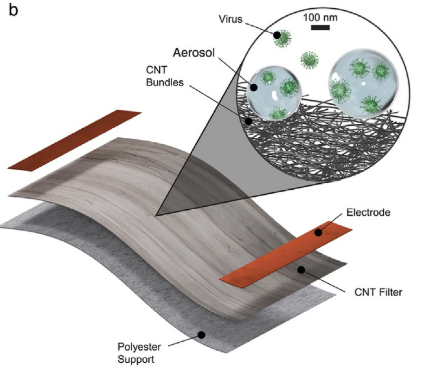
A notable outcome is that our CNT materials have been demonstrated to be excellent multifunctional filtration materials, allowing both capturing and destruction of SARS viruses. This achieved press coverage in the Cambridge Independent and Engineering & Technology and is being commercialized by industrial partners Q-Flo,Tortech and Camfil.
Professor PJ Clarkson, Div C, 2021
Creating a Cambridge People~Systems Experience Laboratory (CaP~SEL)
The concept of the CaP~SEL is to facilitate the diversity of the population to be engaged in the development of service systems, and particularly technical systems. The CaP~SEL could provide the facility in which researchers and industries interested in the relationship between people and systems can coalesce. This brings the potential to bring together diverse disciplines such as architecture, human-computer interaction, psychology, healthcare, as well as engineering and inclusive design to focus on the relationship between people and the systems that they interact with. The facility could provide easy access to the often-missing element, ‘real people’, in the research and development of systems. This could help ensure that future technologies and systems invented, researched and developed in Cambridge are fit for real people to use, and thus can benefit society-at-large.
The Seed Fund part-funded a small architectural scoping project:
- Engagement with Estates and an architectural consultancy, Burwell Associates to scope the facilities for the centre.
- Development of ‘fly-through’ CAD visualisations for the CaP~SEL facility.
- Engagement with academics throughout the University to determine the level of potential interest in the facilities.
Flythrough visualisations were developed to assist with CaP~SEL scoping and communication to stakeholders.
jc_er_flythru_webedit.png
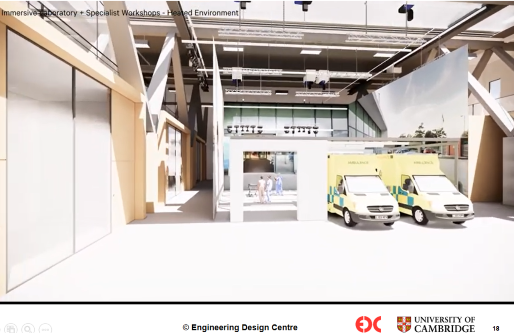
Image from fly-through visualisation showing mock-up of Hospital Emergency Room entrance